Photography for charcuterie and meat producers
A cured meat is sold on what it has inside, and what it has inside only shows when you cut it. From that moment the slice starts to change: the fat warms, the surface dries, and under the lights the red fades. Photographing cured and fresh meat means working on a product that will not keep still, and giving the viewer the same slice they would find at the counter. Not a redder one, not a glossier one: that one.
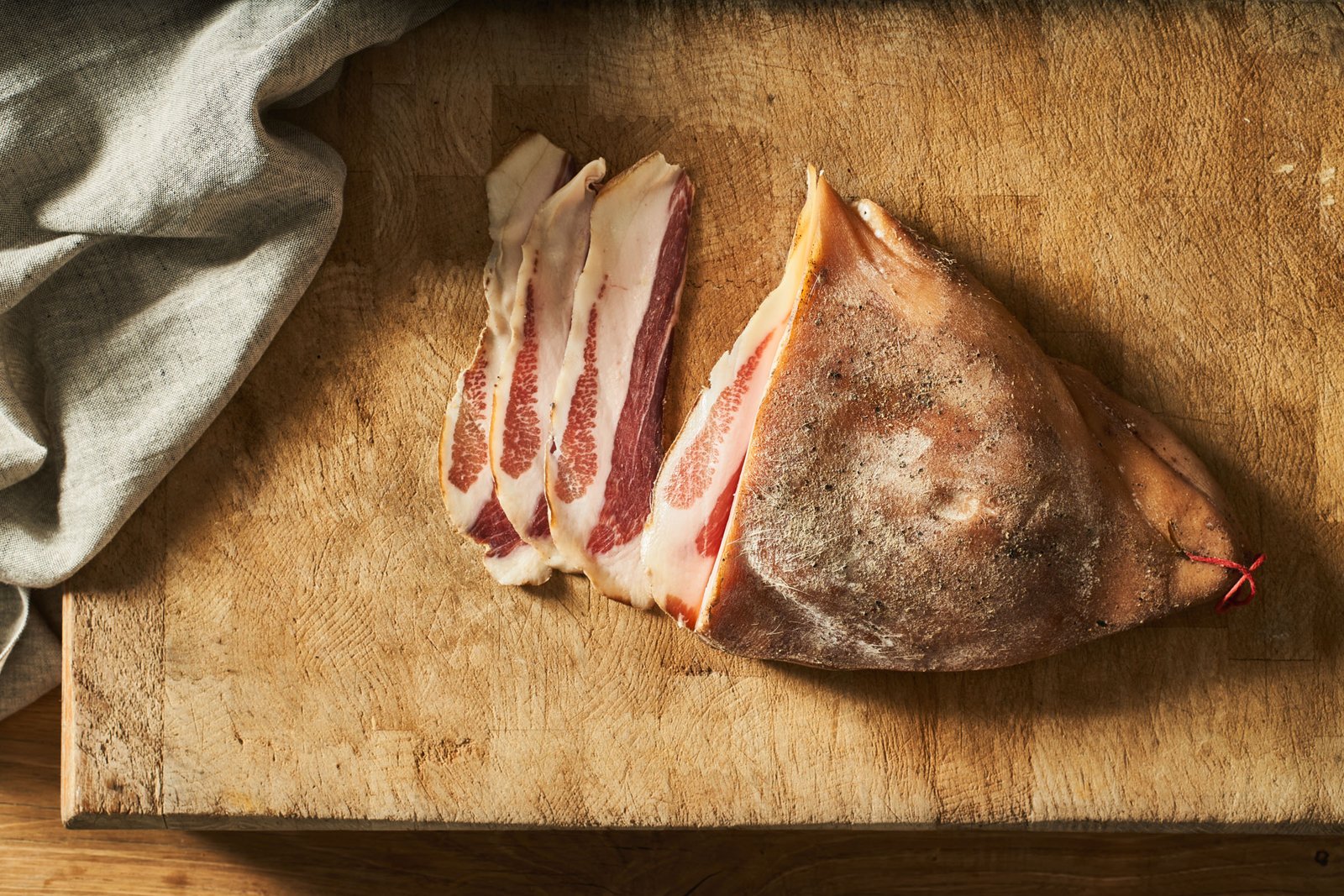
Cured meat is photographed in the cut
From the outside a salami is a closed object: rind, string, casing, the dust of the curing room. Everything that sets it apart from another is inside — the mosaic of a salami, the layers of a guanciale, the spiral of a rolled pancetta, the marbling of a capocollo — and it only shows in cross-section. That is why the set is built around the cut surface, not around the piece. And it is the hardest surface there is: the white of the fat and the brown of the rind sit two centimetres apart, and the wrong exposure loses one of them. Raking light holds them together, and keeps the pattern legible right to the edge of the slice.
From the cut onwards, the clock is running
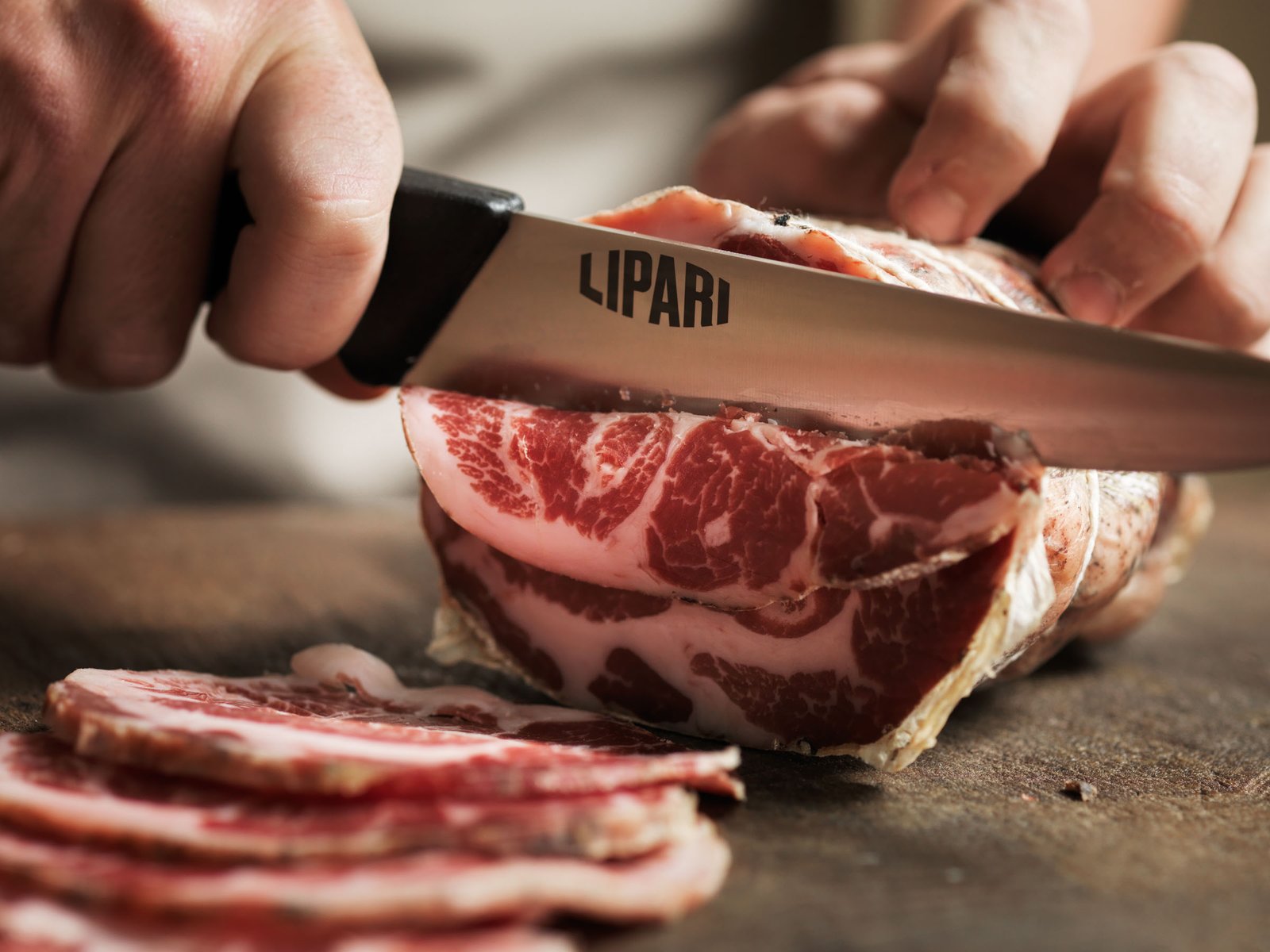
A freshly cut slice and the same slice after twenty minutes on set are not the same product. The fat starts to sweat and turns from matt to glossy, the lean dries and darkens at the edges, the slice curls. So the cut is made on set, in front of the camera, and made again whenever it is needed. With fresh meat the window is tighter still. Vacuum packing gives it back purple, air turns it red, and if you wait too long it drifts towards brown: the red everyone expects only lasts a while, and the set has to be ready before the pack is opened.
Cooked ham throws a rainbow
On a slice of cooked ham or roast beef a green and violet sheen sometimes appears, like oil on water. It is not a defect: it is light breaking up on the muscle fibres, and it depends on how the slice was cut and where the light comes from. In person it shifts as soon as you move your head and you hardly notice it; in a photograph it stays put, and the viewer assumes something is wrong. It is controlled on set, by working the angle of the light and the angle of the slice. It can be taken out afterwards on screen, but the grain of the meat goes with it, and the ham starts to look like plastic.
The pack is a second product
For many shoppers cured meat is not the whole piece: it is the tray in the chiller cabinet. And to a camera it is a different object. The film reflects half the set, condensation fogs the slices, a label printed on a curved, glossy surface has to stay flat and legible, and slices laid out in a row have to look neat without looking fake. This is the photograph that ends up on retail's digital shelf and on e-commerce pages, where your product sits a centimetre away from a competitor's. The same goes for vacuum packs and for the paper band around a salami, which is often the only place your name is written.
Curing is the part nobody sees
The rooms with rows of hanging salami, the hands tying, the white mould flowering on the casing, the time passing: it is the part of your work no customer ever sees, and the one that best tells the difference between you and any other product. It is what the institutional pages need, and the importer's presentation, and the supply-chain and sustainability story. It is photographed at your plant without stopping production, with light equipment and in line with hygiene protocols, agreeing windows and routes with whoever runs the line. And the mould is photographed for what it is: a sign of curing, which in a good image reads as quality, not as dirt.
Which services
See all services-
Packshot & packaging
The product on its own, the way a buyer sees it: on the product page, on the marketplace, in the price list. The same background and light across the range, colour checked against the real pack.
-
Styled food & recipes
The product on the table, on the plate and in the glass. A set built for that product, styling, recipes: the photograph that shows how what you make gets enjoyed.
-
Advertising & catalogues
Catalogues, campaigns, trade-fair material. A direction agreed before the set, holding from the billboard to the price-list page and from one season to the next.
-
Industrial & factory reportage
Raw material, processing, people at work. The story of how the product is made, for the website, importers, retail buyers and the sustainability report.
Let's talk
Tell us what needs photographing
The more detail you give us, the more precise the quote: how many products, which channels the images are for, and when you need them. We reply within one working day.